A medication list holds everything you take: prescriptions, over-the-counter medicines, vitamins, and supplements, with how much, how often, and what each one is for, plus any allergies. Print the list below for every appointment and the pharmacy, or let Kasane, now on the App Store, keep it with the rest of each person's record.
Let Kasane keep the list
Kasane keeps each person's list where their care already happens:
- One list per person. Everyone in the family has a Health profile with their medicines, conditions, and family history, so a parent's list lives on your phone beside yours.
- Pills on their routine. Put a pill habit on breakfast or bedtime, get a reminder at its time, and check it off when it's taken.
- Ask the record. "What does Dad take in the morning?" gets an answer from his own record.
Kasane is on the App Store for iPhone, starting with a free week: download Kasane. Here's a fictional example: Ana, who keeps her father Robert's record.
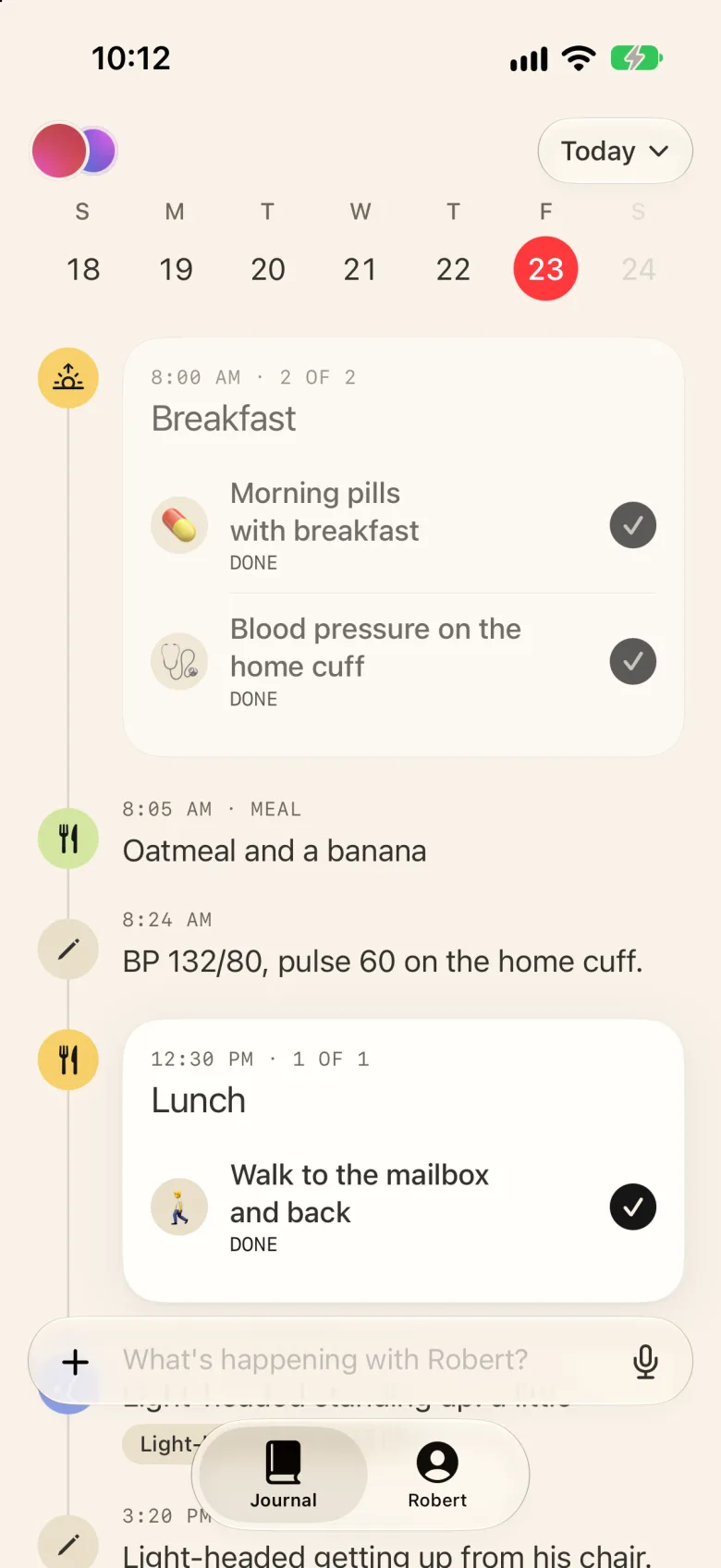
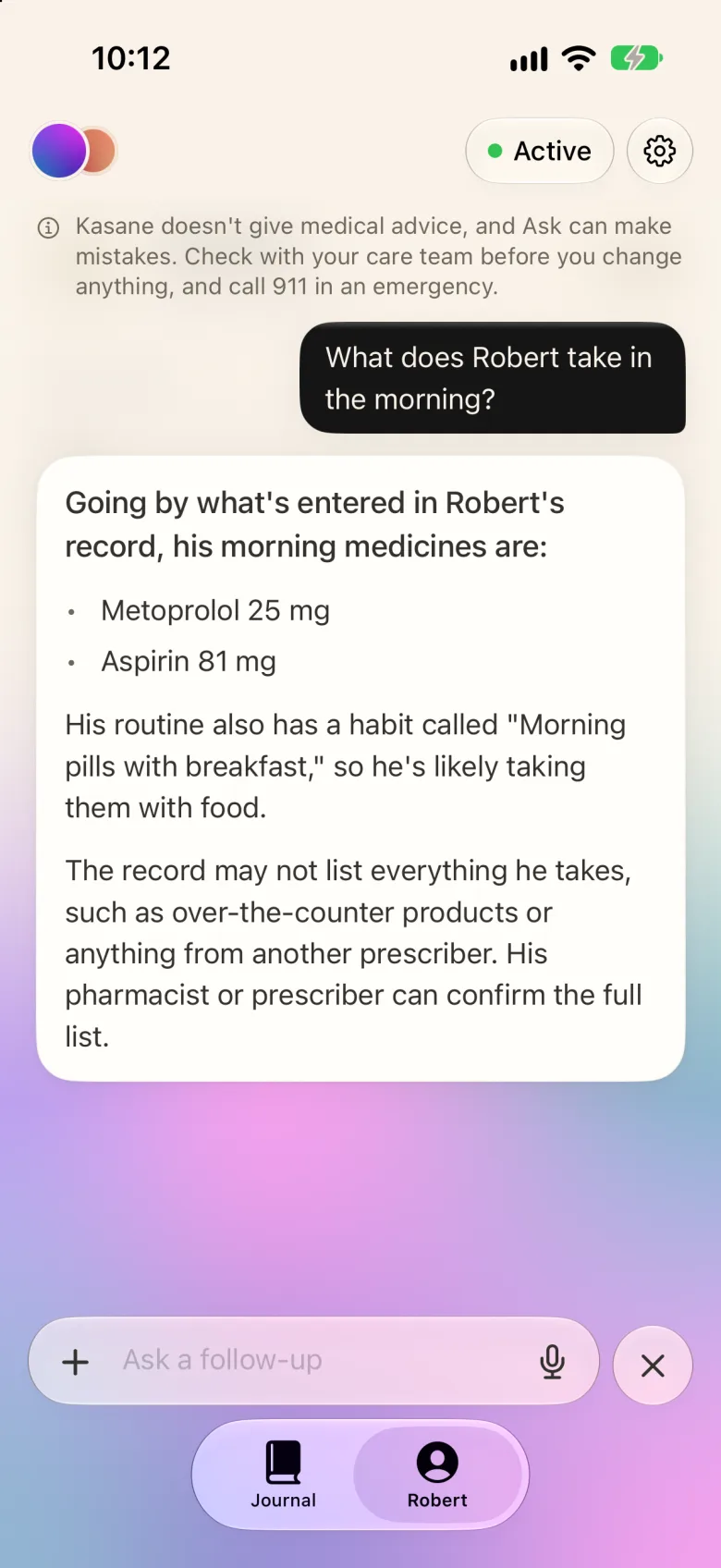
Kasane keeps the list you write. It doesn't check doses or interactions: ask your pharmacist or doctor about those.
What to put on the list
The US government's templates agree on the core fields. AHRQ's list asks for "Name (brand and generic)", "Strength of medicine", "I take this medicine for", and "When, how, and how much I take" (AHRQ). The FDA's My Medicine Record adds "What It Looks Like", "Start / Stop Dates", and "Who Told Me to Use / How to Contact" (FDA).
| Field | Why it's there |
|---|---|
| Name, brand, and generic | The FDA says to "enter the brand and generic name of the medicine, including any samples you are given" (FDA) |
| Strength and how much you take | AHRQ's "Strength of medicine" (AHRQ) and the FDA's "How Much" (FDA) |
| How and when you take it | ODPHP: "Write down how much you use and when you use each medicine" (ODPHP) |
| What it's for | AHRQ's "I take this medicine for" |
| Who prescribed or recommended it | The FDA's "Who Told Me to Use / How to Contact" |
| Start date | The FDA's "Start / Stop Dates" |
| Allergies and past reactions | ODPHP says to tell your doctor "If you're allergic to any medicines" and "If you've had side effects after using any medicines" (ODPHP) |
| The date you last updated it | AHRQ says to "update My Medicines List every time you start, stop, or change a medicine." (AHRQ) |
Don't skip the over-the-counter section
Supplements and non-prescription medicines belong on the list too. AHRQ notes that "Non-prescription medicines may include vitamins, herbals, supplements, cold or cough medicines" (AHRQ), and the FDA's form has its own rows for "Dietary supplements, including vitamins, minerals, and herbals" (FDA). In a 2002 US survey, adults who used herbs or supplements were mostly silent about it: "only one-third told their physician about this use" (Kennedy et al. 2008).
Why a written list helps
Clinic and hospital records often miss what people actually take. Researchers who compared pill bottles with clinic records in one practice found "Discrepancies were present in 239 patients (76%)" (Bedell et al. 2000), and a review of hospital admissions found "Errors in prescription medication histories occurred in up to 67% of cases" (Tam et al. 2005).
Patient-made lists have gaps of their own. In one study of people before surgery, "Most personal lists were incomplete (56%; 46/82)" (Lee et al. 2014). That's why the sheet below asks for dose and frequency on every line and has a separate section for over-the-counter medicines and supplements.
Prefer paper?
Print the list, or save it as a PDF. Use one sheet per person, with their name at the top.
Update it every time you start, stop, or change a medicine. This list records what you write; ask your pharmacist or doctor about doses and interactions.
Bring it to every appointment and to the pharmacy.kasanelife.com/printables/medication-list
Keep it with you, and keep it current
- Bring it to every visit. ODPHP: "Take the list with you whenever you go to a medical appointment." (ODPHP)
- Take it to the hospital. AHRQ: "Take it with you if you go to the hospital, so that everyone will know what medicines you take." (AHRQ)
- Give someone a copy. The FDA says "It is a good idea to give a copy to a friend or loved one." (FDA)
- Update it every time you start, stop, or change a medicine, as AHRQ says (AHRQ), and change the date at the top.
Questions people ask
What should a medication list include?
Every medicine's name (brand and generic), strength, how much and when you take it, what it's for, who prescribed it, and when you started, plus allergies and the date you last updated it. Those fields come from the AHRQ and FDA templates (AHRQ, FDA).
Should I list vitamins and supplements?
Yes. ODPHP says to "Keep a list of all the medicines, vitamins, minerals, and herbs you use" (ODPHP).
Can I keep a list for a parent or child?
Yes. Give each person their own sheet with their name at the top, and keep a copy wherever their care happens. In Kasane, each person in the family has their own Health profile.
When to see a doctor or pharmacist
- If you forget how to use a medicine, ODPHP says to "ask a pharmacist if you forget how to use a medicine" (ODPHP).
- If a refill looks different, "ask your pharmacist to double-check that you have the right medicine" (ODPHP).
- Don't stop a prescription on your own: "keep taking your prescription medicines until your doctor tells you it's okay to stop" (ODPHP).
- If someone takes a medicine by accident, call Poison Control at 1-800-222-1222 (ODPHP). In an emergency, call 911 first.