A family health history lists your close blood relatives on both sides of the family, the conditions each one has had, how old they were when diagnosed, and, for relatives who have died, the cause and age of death. Print the template below for your next appointment, or let Kasane, now on the App Store, keep it with the rest of each person's record.
Let Kasane keep it
Kasane keeps a family history for each person, with the rest of their record:
- Kept with the person. Each Health profile holds the conditions in that person's family, who had them, and about when.
- One for each of you. Your family history and your parent's are different lists, and Kasane keeps them apart.
- Read with everything else. When you ask about someone, Ask reads their family history alongside their conditions, medicines, and journal.
Kasane is on the App Store for iPhone, starting with a free week: download Kasane. Here's a fictional example: Ana, who keeps her father Robert's record.
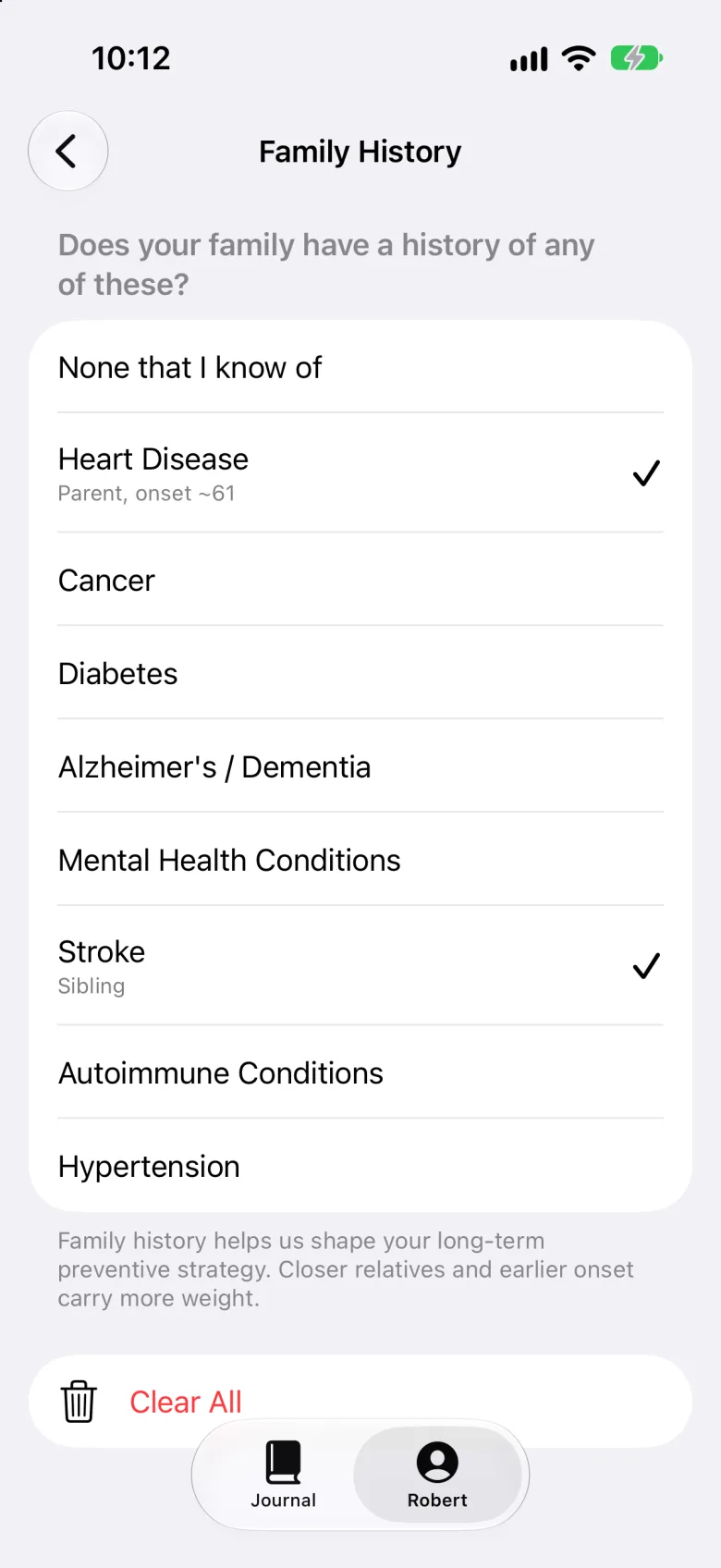
Kasane records what you know. It doesn't calculate risk: what a family history means for you is a conversation with your doctor.
Who and what to include
The CDC describes family health history as "a record of the diseases and health conditions in your family" (CDC), and says to collect information from "close blood relatives from both sides of the family" (CDC).
| For each relative | Why it's there |
|---|---|
| Who they are, and which side of the family | The CDC lists "your parents, sisters, brothers, half-sisters, half-brothers, children, grandparents," aunts, uncles, nieces, and nephews (CDC) |
| Conditions, and the type of cancer if any | The CDC suggests asking about chronic diseases "such as heart disease or diabetes", and "What type of cancer?" (CDC) |
| Age at diagnosis, even a rough one | "knowing the approximate age is still useful" (CDC) |
| Living or not, age or age at death, and the cause of death (in Notes) | The CDC asks you to "Include information on major medical conditions, causes of death, age at disease diagnosis," plus "age at death, and ethnic background" (CDC) |
| Family ancestry, optional (in Notes) | The CDC suggests asking "What is our family's ancestry?" (CDC) |
The template groups parents, siblings, and children apart from grandparents, aunts, and uncles. A review of 14 studies found that people's reports of cancer in first-degree relatives "are accurate and valuable for breast and colon cancer risk assessments" (Murff et al. 2004), and that reports about more distant relatives tended to be less accurate, so it helps to keep the two apart. Mark anything you're not sure about in Notes.
Prefer paper?
Print the template, or save it as a PDF. Use one per person, with their name at the top.
Write down what you know, even a rough age. A family history doesn't mean you'll get a condition; what it means for you is a conversation with your doctor.
Close relatives first, kept apart from the rest.kasanelife.com/printables/family-health-history
How to fill the gaps
- Ask at family gatherings. The CDC suggests you "use family gatherings as a time to talk about health history" and "look at death certificates and family medical records" (CDC).
- Write down what you know. "Even if you don't know all of your family health history information, share what you do know." (CDC)
- Keep it current. The CDC says to "update it whenever you learn new family health history information" (CDC). Write the date at the top each time you update it.
Questions people ask
Why do doctors ask about family history?
The CDC says it "can help your healthcare provider decide which screening tests you need and when those tests should start" (CDC). It isn't only about genes: families also share habits and surroundings (CDC).
Does a condition in my family mean I'll get it?
No. The CDC says a family history of a disease "doesn't mean that you or your family members will definitely get it" (CDC).
Is there a free government family health history tool?
Yes. My Family Health Portrait was created by the National Human Genome Research Institute and is now managed by the National Cancer Institute. It also keeps your answers on your own device: "your information is not transmitted back to government or other servers" (My Family Health Portrait).
What family history does a GI doctor ask about?
NIDDK lists family history of digestive diseases such as celiac disease, colon cancer, and inflammatory bowel disease (NIDDK). For the rest of that visit, see how to prepare for a gastroenterologist appointment.