A medical binder keeps your health records in one place you can grab for an appointment or an emergency: who you are and who to call, your care team, your medicines and allergies, your conditions and tests, your vaccine records, and your family history. Print the checklist below and fill each section with the printables linked from it, or let Kasane, now on the App Store, keep the same record for each person in your family.
In an emergency, call 911 first. The binder is for what comes after: the ER, a new doctor, or a family member stepping in.
Let Kasane be the binder
Kasane keeps a binder's worth of record for each person, and lets you ask about it:
- One record per person. Medicines, conditions, family history, labs, documents, and the care team, for each person in the family.
- Records go in as photos or PDFs. Kasane reads lab values and dates from them for you to confirm.
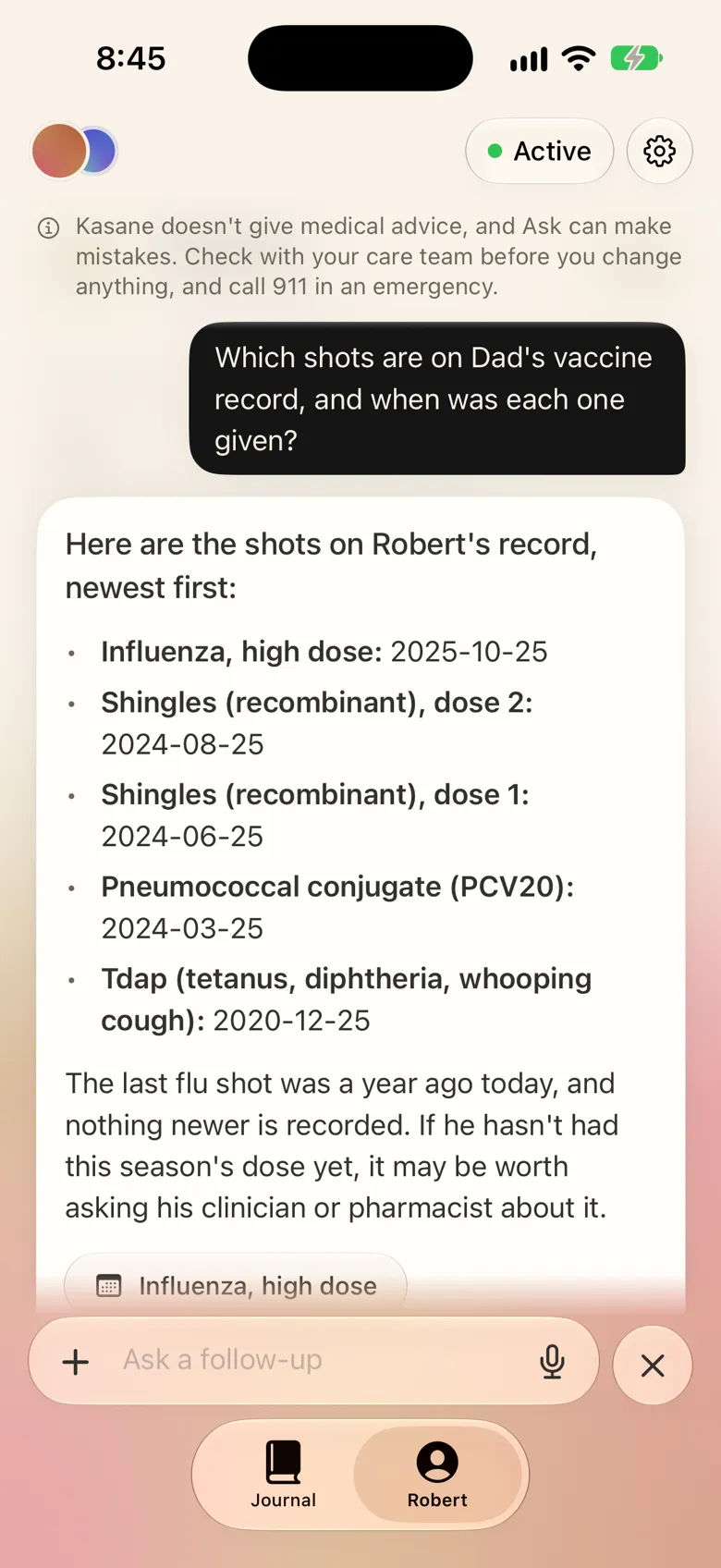
- Ask instead of flipping tabs. "Which shots are on Dad's vaccine record?" gets an answer from his record, with each source linked.
Kasane is on the App Store for iPhone, starting with a free week: download Kasane. Here's a fictional example: Ana, who keeps her father Robert's record.
What goes in it
We couldn't find a government or medical-society page that defines a "medical binder", so we built these sections from the sources that describe a personal health record. The National Library of Medicine says "it's a good idea to keep your own personal health record" and suggests starting with your name, birth date, blood type and emergency contacts, the "Date of last physical", "Dates and results of tests and screenings", "Major illnesses and surgeries, with dates", your medicines and supplements, "Any allergies", "Any chronic diseases", and "Any history of illnesses in your family" (MedlinePlus).
| Section | Where it comes from |
|---|---|
| About me and emergency contacts | MedlinePlus's list, and the "Emergency Contact" box on the FDA's medicine record (FDA) |
| Care team: doctors, pharmacy, and how to reach them | The FDA's "Primary Care Physician" and "Pharmacy / Drugstore" boxes |
| Medications and supplements | The medication list |
| Allergies and past reactions | MedlinePlus's "Any allergies" |
| Conditions, illnesses, and surgeries, with dates | MedlinePlus, and the FDA's "My Medical Conditions and Operations" |
| Tests and screenings, with dates and results | MedlinePlus |
| Vaccination records | HealthIT.gov lists immunizations in your health record (HealthIT.gov); see how to get your vaccine records |
| Family health history | The family health history |
| Copies of records from your providers | HealthIT.gov, below |
| Visit notes and questions | The FDA's "Questions I Should Ask About Medicines or Dietary Supplements" box, and our guide to turning your notes into a visit summary |
Insurance cards, advance directives, and legal papers often go in a binder too. We haven't sourced guidance on them yet, so they're not in this version.
Prefer paper?
Print the checklist, or save it as a PDF, and put it on the front of the binder. The medication list and family health history have sheets of their own.
Tick each section once it's in the binder. Put the date on the front every time you update it.
- Name and date of birth
- Blood type, if you know it
- Emergency contacts
- Primary care doctor and phone
- Pharmacy and phone
- Other doctors and how to reach them
- Print the medication list: kasanelife.com/printables/medication-list
- What you reacted to
- What happened
- Ongoing conditions
- Major illnesses and surgeries, with dates
- Date of last physical
- Tests and screenings, with dates and results
- Print the family health history: kasanelife.com/printables/family-health-history
- Notes from your visits
- Test results
- Treatment records
In an emergency, call 911 first. The binder is for what comes after: the ER, a new doctor, or a family member stepping in.
One binder per person.kasanelife.com/printables/medical-binder
Get copies of your records
Your doctors' records belong in the binder too. HealthIT.gov says a health record "includes information about medications, treatments, tests, immunizations, and notes from health care provider visits", and that HIPAA "gives you the right to see and get a copy of your health record" (HealthIT.gov). Its guide also covers getting records as a caregiver for "a minor child or an elderly parent".
Questions people ask
What should be in a medical binder?
Start with the sections above, which we built from MedlinePlus, the FDA's medicine record, and HealthIT.gov: who you are and who to call, your care team, medicines and allergies, conditions and surgeries, tests, vaccines, and family history. Add copies of records from your providers as you get them.
Who controls a personal health record?
You do. CMS describes a personal health record as one that "is controlled by the individual, and can be shared with others, including caregivers, family members and providers" (CMS).
Paper binder or app?
Either works if it's current and you can find it when you need it. In our view, paper is easy to hand to a doctor or a family member, and an app is easier to keep current and to search. Whatever you use, keep the date you last updated it in view.