Reintroduce FODMAPs one group at a time: eat a food rich in only that group once a day for 3 days, then take a 2 to 3 day break, or until symptoms settle, before the next test. This printable log plans each challenge and records what happened, and Kasane, now on the App Store, keeps the meals and symptoms underneath, so you and your dietitian can see which groups you tolerate.
How the reintroduction step works
Monash University runs low-FODMAP in three steps. This log is for step 2.
- Step 1, swap: replace high-FODMAP foods with low-FODMAP ones. Monash says "Follow the Step 1 diet for 2-6 weeks." (Monash).
- Step 2, reintroduce: each challenge means "eating a food rich in only 1 FODMAP group daily for 3 days" (Monash). "Wait until your symptoms are well controlled before beginning each challenge", and "Take a 2-3 day break between challenges, or until symptoms settle." (Monash). Your background diet stays low-FODMAP during the tests (Monash).
- Step 3, personalize: with your dietitian, keep avoiding only the foods that triggered your symptoms, and bring the rest back (Monash).
Monash says the reintroduction step takes most people "around 6 to 8 weeks" (Monash). The British Society of Gastroenterology, a UK body, says low-FODMAP "should be supervised by a trained dietitian" (BSG 2021, PDF hosted by BSPGHAN).
Before you start
- Get tested for celiac disease first. Step 1 cuts wheat, and the UK's NICE says a celiac test "is accurate only if a gluten‑containing diet is eaten during the diagnostic process" (NICE NG20).
- Don't use a challenge to test a suspected allergy. "If you think you have a food allergy, you will need specialist input" (the UK's BDA). Call 911 (the NHS page gives the UK number) if "your lips, mouth, throat or tongue suddenly become swollen", if you're breathing fast or with difficulty, or if "your throat feels tight or you're struggling to swallow" (NHS).
- If you've had an eating disorder, or cutting foods makes you anxious or makes you eat less, talk to your doctor before starting. The National Alliance for Eating Disorders runs a free helpline with therapists: call (866) 662-1235, Monday to Friday, 9 am to 7 pm Eastern (National Alliance for Eating Disorders).
- For a child, or if you're pregnant, talk to your pediatrician, doctor, or dietitian before changing what's eaten.
- Ask your dietitian which food to use for each challenge, so each one tests a single FODMAP group.
Let Kasane keep the journal underneath
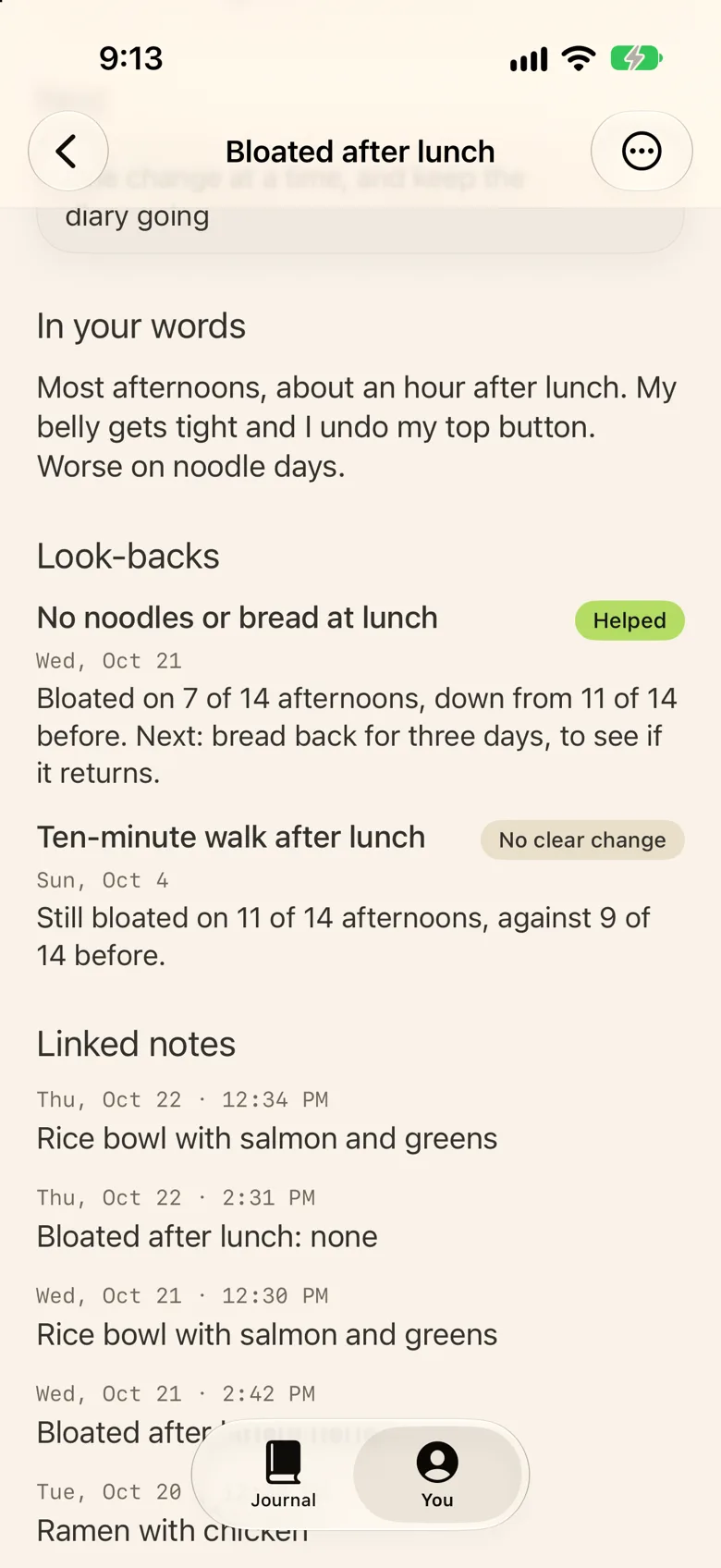
Kasane keeps the food and symptom journal that the challenges sit on: what you ate and when, and how you felt, each line at its time. It's on the App Store for iPhone, starting with a free week: download Kasane. In this fictional example, Priya ends a two-week try by bringing bread back for three days, the same shape as a challenge.
Your reintroduction log
Print it, or save it as a PDF for your dietitian. Use one row for each challenge, in the order your dietitian suggests.
One group per challenge: fructose, lactose, sorbitol, mannitol, fructans, or GOS, in the order your dietitian suggests. Eat the food once a day for 3 days, then take a 2 to 3 day break, or until symptoms settle. Each day, write how you felt: none, a little, or a lot.
Keep the rest of your diet low-FODMAP during the tests. A challenge tests symptoms, never a suspected allergy. If a warning sign shows up, stop and see a doctor.
One group at a time keeps each result readable.kasanelife.com/tools/low-fodmap-reintroduction-log
Reading your results
Write down what you noticed for each group, and keep the conclusions for you and your dietitian. Two things from the sources help:
- One group at a time is what makes a result readable. Monash says to reintroduce FODMAPs "one at a time, so you get clear results" (Monash).
- Tolerance can change. "FODMAP tolerance can change over time" (Monash), so a group that bothered you once can be tried again later.
Low-FODMAP isn't meant to be forever. Monash warns that "Over-restriction of FODMAPs may reduce your intake of nutrients" (Monash).
Questions people ask
How long does FODMAP reintroduction take?
Monash says most people take about 6 to 8 weeks to finish the reintroduction step (Monash).
How long is each challenge?
Three days for each food, starting when your symptoms are settled, with a 2 to 3 day break afterwards, or until symptoms settle (Monash).
Does everyone respond to low-FODMAP?
No. Monash says "Not everyone with IBS will improve on a low FODMAP diet" (Monash). Our suggestion: if step 1 didn't help, talk to your dietitian before going further.
Is low-FODMAP an elimination diet?
Monash says "a low FODMAP diet is not an elimination diet": step 1 swaps foods for lower-FODMAP versions rather than cutting food groups (Monash).
When to see a doctor
Don't use a diet to manage symptoms that need a doctor. NIDDK lists bleeding from your rectum, "bloody stools or stools that are black and tarry", weight loss, and anemia as signs that point to a condition other than IBS (NIDDK). The American College of Gastroenterology adds "New symptoms later in life" and a family history of colon cancer (ACG).