Write down what you eat and drink, when, and what symptoms follow, with the time and how strong they were. Kasane, now on the App Store, makes each of those a line you type or say, and its questions read the pattern from your own days; if you'd rather use paper, there's a printable food and symptom journal.
Let Kasane keep the diary
Kasane makes the diary quick to keep, then connects the dots with you:
- Log it the way you'd text it. Type or say what you ate or how you feel, and each line lands at its time, tagged as a meal, a symptom, or a note.
- Meals and symptoms on one timeline. Your day reads in order, so what came before a rough afternoon is right there.
- The dots, connected from your own days. Name your question in your own words, and Kasane reads what your journal holds: which lunches were followed by bloating, and which weren't.
Kasane is on the App Store for iPhone, starting with a free week: download Kasane. Here's a fictional example: Priya, who's bloated most afternoons and a few days into a two-week try.
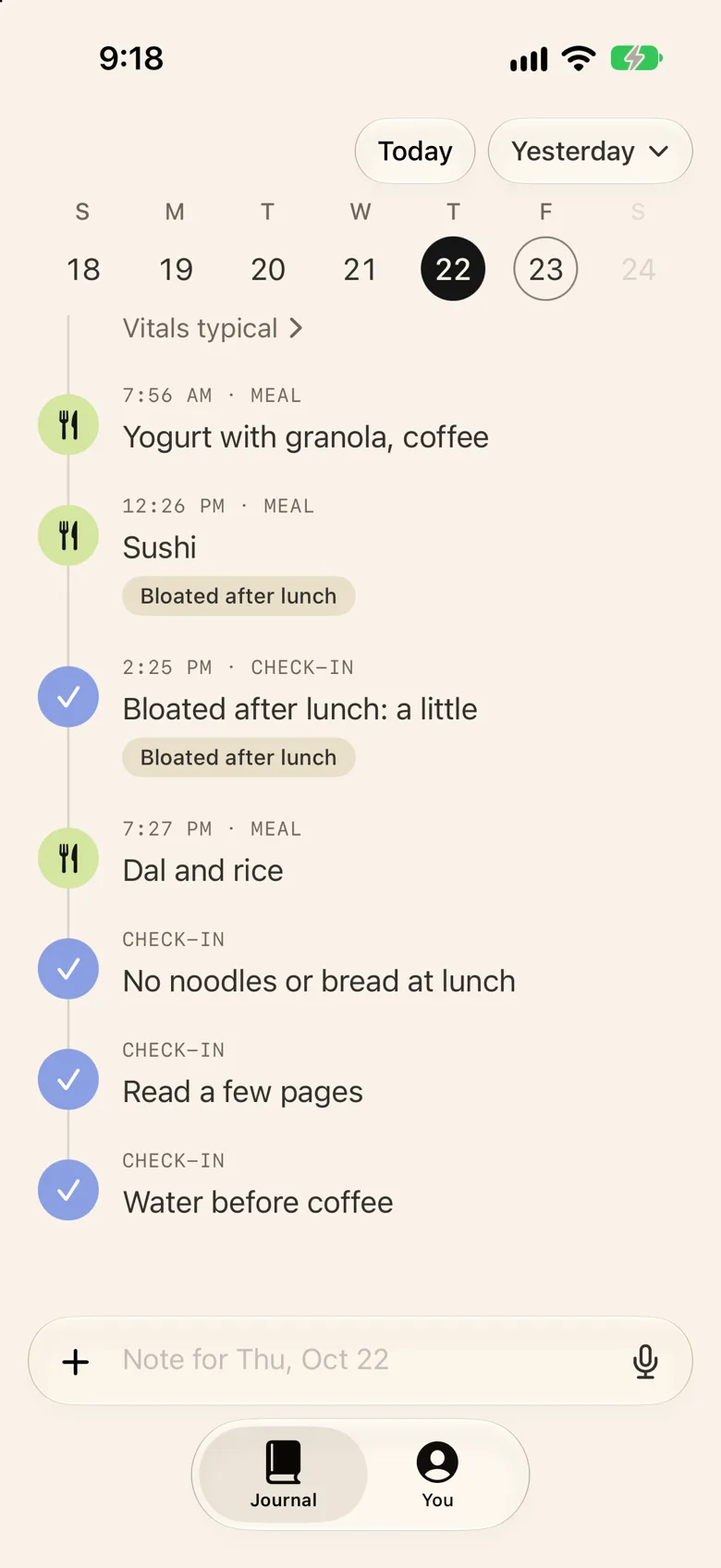
It's the same diary described below, written in sentences: Priya writes what she ate or how she feels, the way she'd text it.
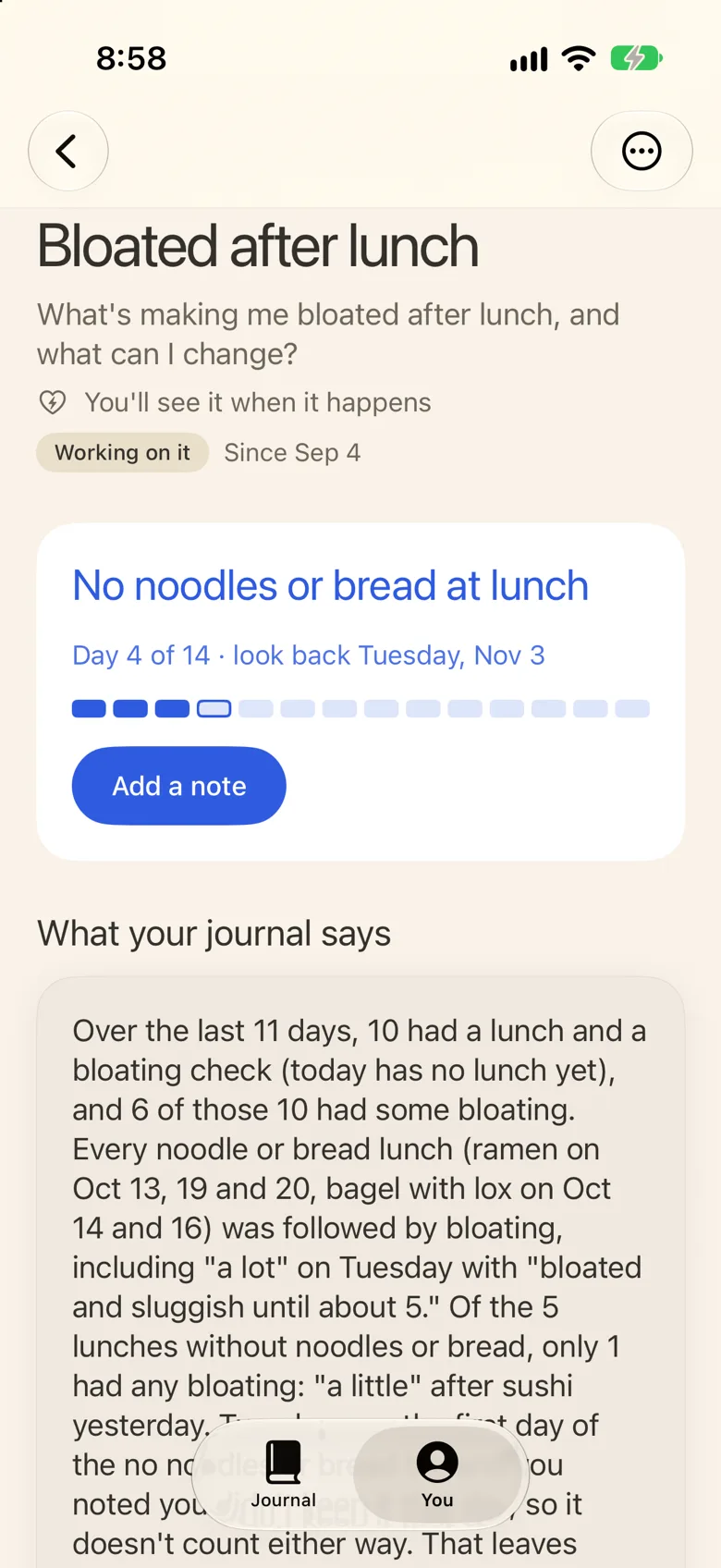
The pattern shows up on her question's page, counted from her own entries. Her try cuts noodles and bread at lunch, so if celiac disease were possible, testing would come first.
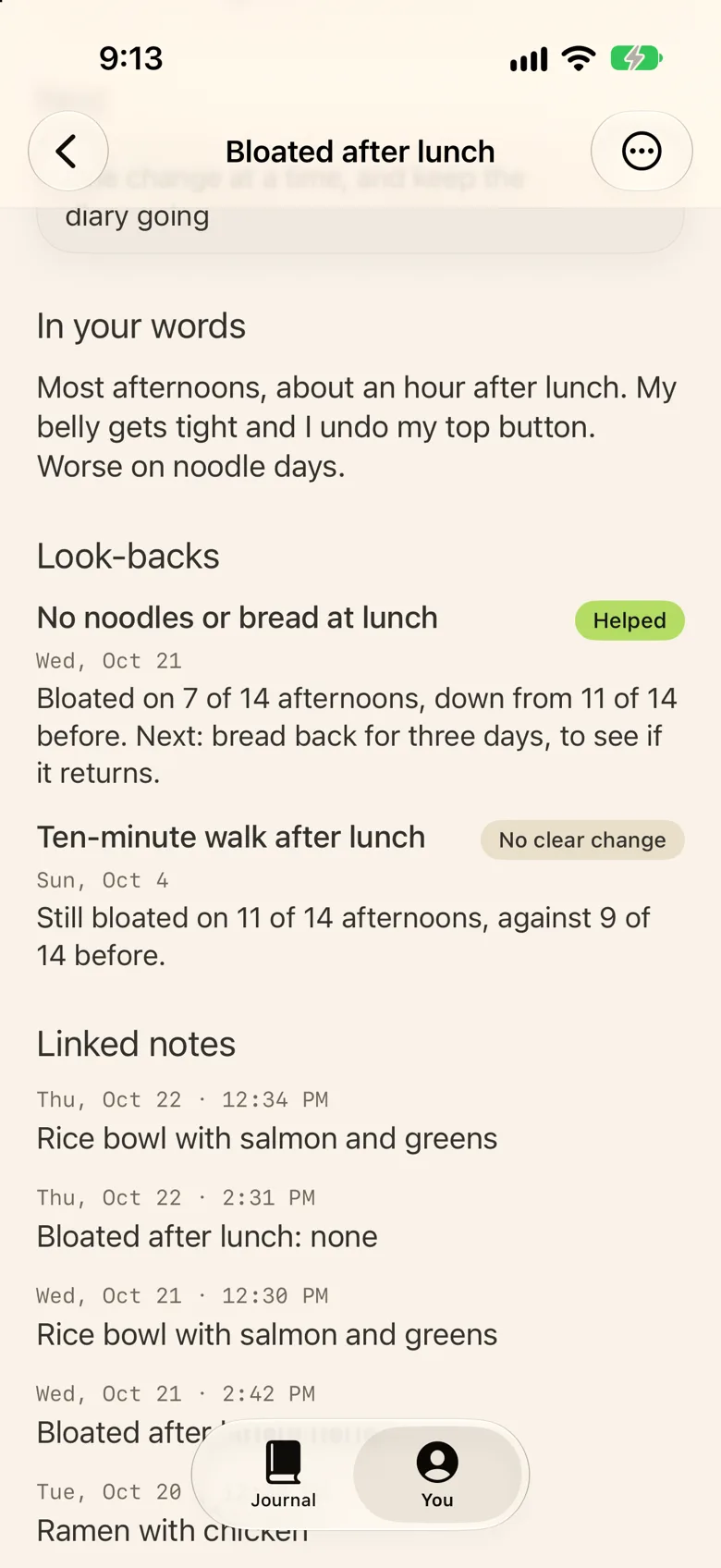
A look-back is a call on one try. It's a strong clue, and the guidelines' advice still holds: one change at a time, and a dietitian for anything bigger.
The five things clinicians ask you to record
NIDDK describes a diary of "the foods and drinks you consume and when your gas symptoms occur" (NIDDK), and the UK's NHS gives the same advice for IBS (NHS). The diary Monash University uses for its low-FODMAP program adds symptom type, severity, bowel habit, and stress (Monash). So a good diary records:
| Field | Why it's there |
|---|---|
| What you ate or drank, and when | Food intolerance symptoms usually come "a few hours after eating" (NHS), so the time matters |
| Symptom type and strength (0 to 3) | Monash's diary records "IBS symptom type and severity". The 0 to 3 scale is ours |
| Bowel movements, by Bristol type | The UK's NICE guideline suggests the Bristol Stool Form Scale for describing stool form (NICE) |
| Stress and sleep | Monash's diary records stress levels alongside food. Sleep is our addition |
| Medicines and supplements | Doctors ask what you take, including over-the-counter products (NIA) |
If you've had an eating disorder, or keeping a food diary makes you anxious or makes you eat less, stop and talk to your doctor first. The National Alliance for Eating Disorders runs a free helpline with therapists: call (866) 662-1235, Monday to Friday, 9 am to 7 pm Eastern (National Alliance for Eating Disorders). For a child, or if you're pregnant, talk to your pediatrician, doctor, or dietitian before changing what's eaten.
Reading the Bristol scale
The Bristol Stool Form Scale sorts stool into seven types. A 1997 study of 66 volunteers found that "a stool form scale can be used to monitor change in intestinal function" (Lewis & Heaton 1997), and a 2016 study in healthy adults and people with diarrhea-predominant IBS found it has "substantial validity and reliability", with three groups: "hard (Types 1-2), normal (Types 3-5) and loose stools (Types 6-7)" (Blake et al. 2016). The same study found "difficulties arose around clinical decision points (Types 2, 3, 5, 6)", so take a second look at those.
| Type | What it looks like | Group |
|---|---|---|
| 1 | Small hard pellets, separate from each other | Hard |
| 2 | One firm, lumpy log | Hard |
| 3 | A firm log with cracks across the surface | Normal |
| 4 | A smooth, soft log | Normal |
| 5 | Soft pieces that keep their shape | Normal |
| 6 | Loose, mushy pieces with fuzzy edges | Loose |
| 7 | Liquid, with nothing solid | Loose |
The descriptions and drawings are ours, written to match the scale's seven types.
How to get an answer out of it
A diary is a record. If you and your doctor or dietitian decide to try a change, test one at a time against it. The UK's British Dietetic Association says to "make one change at a time so that you can see what has helped" (BDA).
- Start with your usual eating for a week or two, so you have something to compare against. We suggest this; no guideline sets a number.
- Change one thing, keep the diary going, and write down what you changed and when in the "What I've tried" box.
A diary lines up meals and symptoms by time. Naming a trigger is a judgment for you and your clinician to make together.
What to bring to your appointment
NIA says a doctor will ask when symptoms started, what time of day they happen, how long they last, how often, and whether they're getting better or worse (NIA). NIA also asks you to "be clear and concise", so bring a one-page summary with your diary behind it. For the rest of the visit, see how to prepare for a gastroenterologist appointment.
Prefer paper?
The printable food and symptom journal gives each day one page, one line per entry: the time, the kind, and what happened in your words. A two-week try sheet for testing one change comes with it.
Questions people ask
How long should I keep a food diary for IBS?
For as long as you're making changes. The BDA says to "keep a food and symptom diary whilst you are making changes" (BDA). We couldn't find a GI guideline that sets a fixed number of days, so be wary of any promise of a trigger in a set time.
Should I cut foods out before I start?
No. Keep eating as you usually do at first, so the diary shows your normal pattern. The NHS says not to cut foods out of your or your child's diet without advice from a doctor or dietitian (NHS).
Do I need a dietitian?
For anything beyond simple changes, guidelines say yes. NICE says further dietary advice should "only be given by a healthcare professional with expertise in dietary management" (NICE), and the British Society of Gastroenterology says low-FODMAP should be "supervised by a trained dietitian" (BSG 2021, PDF hosted by BSPGHAN).
Should I stop eating gluten before I see a doctor?
Not before you've been tested for celiac disease. NICE says the test "is accurate only if a gluten‑containing diet is eaten during the diagnostic process", advises eating "gluten in more than 1 meal every day for at least 6 weeks" before testing, and says "not to start a gluten‑free diet until diagnosis is confirmed" (NICE NG20).
Is this the same as a low-FODMAP diet?
No. This diary works with any approach. If you and your dietitian try low-FODMAP, the reintroduction log tracks its test phase.
When to see a doctor
See a doctor before relying on a diary if you have any of these. NIDDK lists bleeding from your rectum, "bloody stools or stools that are black and tarry", weight loss, and anemia as signs that point to a condition other than IBS (NIDDK). The American College of Gastroenterology adds "New symptoms later in life" and a family history of colon cancer (ACG), and the BDA adds "a family history of bowel or ovarian cancer" (BDA). If a new symptom like these starts while you're tracking, see a doctor rather than waiting for the diary to explain it.
- See a doctor if "you need to avoid lots of different foods to control your IBS symptoms" (NHS), or if you're struggling or eating less: the BDA says "Seek specialist advice if you are struggling or dietary intake becomes limited" (BDA).
- A suspected food allergy is a different path: "If you think you have a food allergy, you will need specialist input" (BDA).
- Call 911 (the NHS page gives the UK number) if "your lips, mouth, throat or tongue suddenly become swollen", if you're breathing fast or with difficulty, or if "your throat feels tight or you're struggling to swallow" (NHS).