Keep a sleep diary for two weeks, filling it in each morning: when you went to bed, how long it took to fall asleep, how often you woke, and when you got up. Kasane, now on the App Store, does the counting for you: each morning opens with when you slept and for how long, from Apple Health, and an experiment's look-back counts the mornings for you. If you'd rather use paper, there's a printable sleep journal.
Let Kasane do the math
Kasane keeps the diary with you:
- The night fills itself in. With Apple Health connected, each morning opens with when you slept, for how long, and five overnight readings against your own usual range.
- The evening is one line at a time. Type or say it the way you'd text it: coffee at 4, a glass of wine, a late run. Each line lands at its time.
- The pattern gets counted for you. Name your question, try one change for a few weeks, and the look-back counts the mornings it came up.
Kasane is on the App Store for iPhone, starting with a free week: download Kasane. Here's a fictional example: Dana, who's been waking around 3am most nights since July.
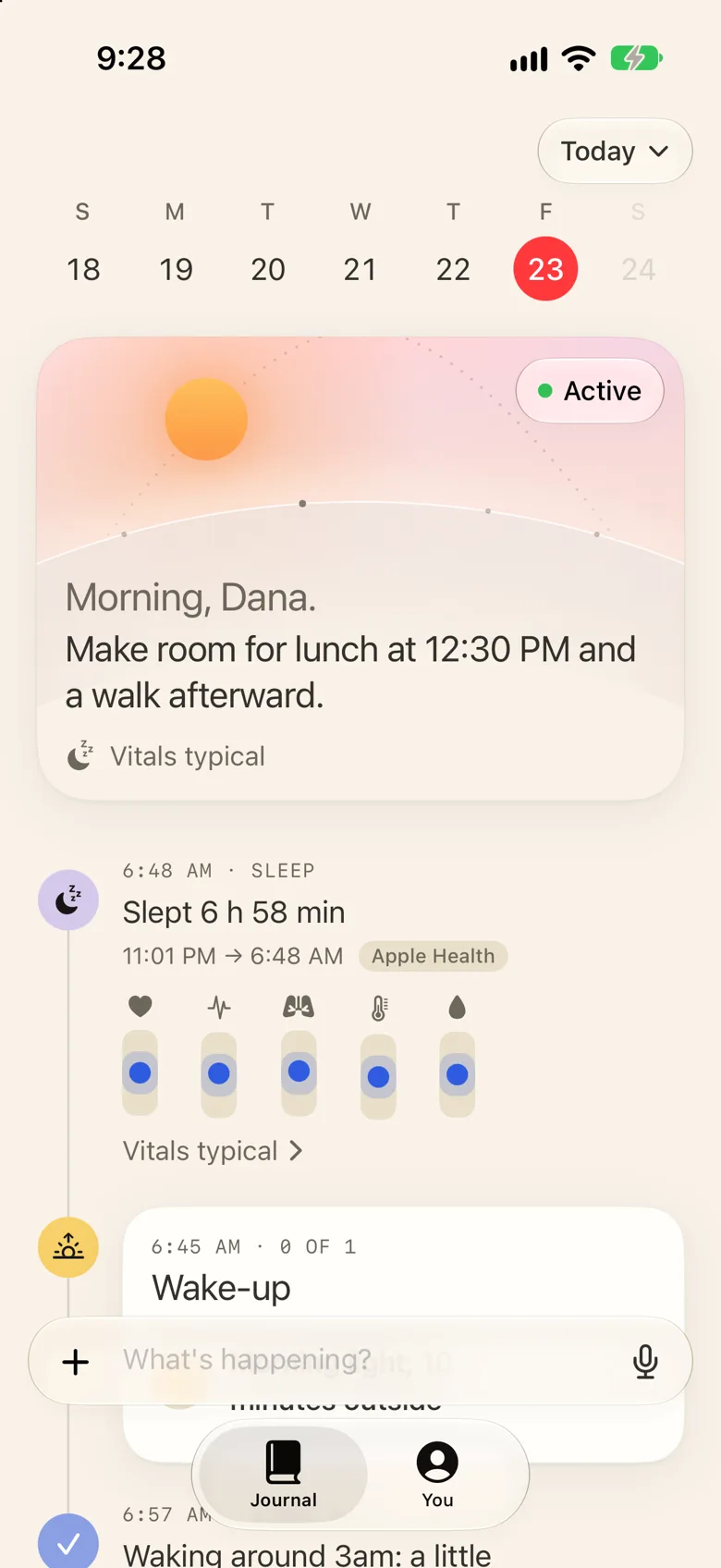
Kasane works out Dana's usual range for each overnight reading (heart rate, heart rate variability, breathing rate, wrist temperature, and blood oxygen) from the four weeks before, so last night reads against her own nights.
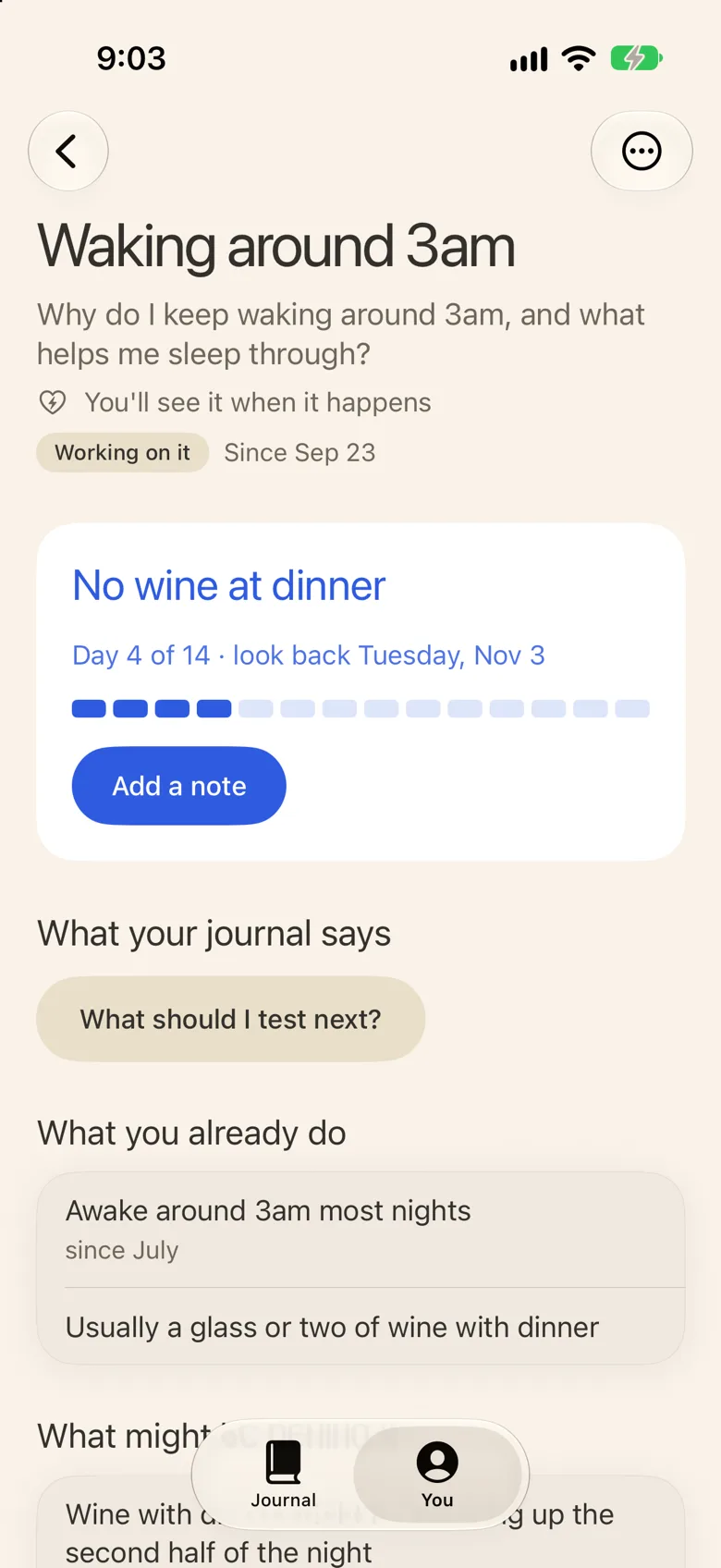
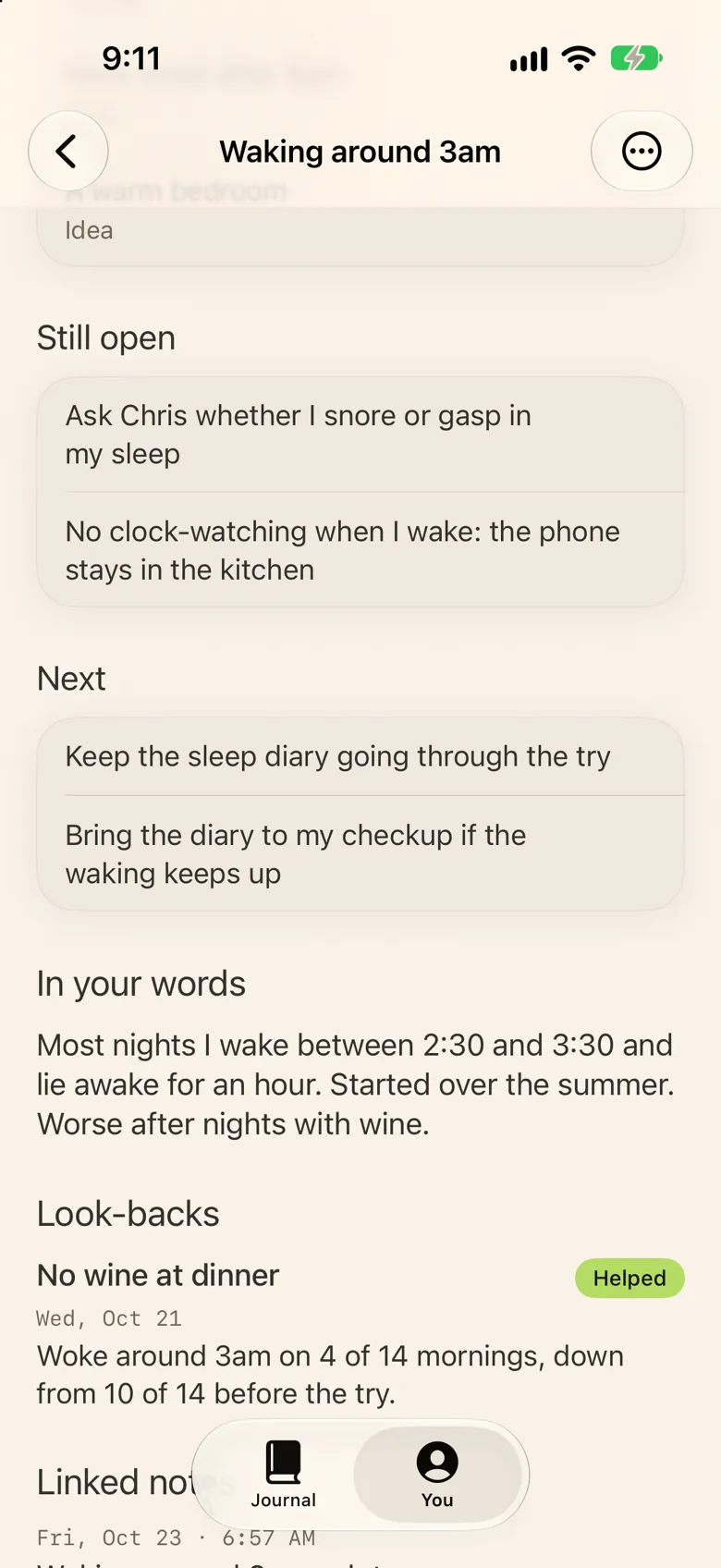
Sleep varies from night to night, so the look-back compares fourteen mornings with fourteen mornings and counts them for her. If her doctor asks for the sleep-log numbers below, the printable has a box for each thing they're worked out from; Kasane keeps the nights and everything around them.
Why two weeks
The American Academy of Sleep Medicine's guideline on chronic insomnia in adults uses "a two-week sleep log" to see your general sleep and wake pattern (AASM 2008). Its patient site says "A typical sleep diary covers a two-week period." (sleepeducation.org), and the NIH's heart, lung, and blood institute says "It may be helpful to keep a sleep diary for 1 to 2 weeks before seeing your doctor." (NHLBI).
The numbers a sleep diary uses
These are the sleep-log definitions in the AASM 2008 guideline (AASM 2008). Write the left column down each morning, and the right column follows from it.
| Write down each morning | What it gives you |
|---|---|
| Time you got into bed, and time you got out of bed | Time in bed: "time from bedtime to getting out of bed" |
| Minutes it took to fall asleep | Time to fall asleep, counted from bedtime |
| How many times you woke, and for how long in total | Time awake after first falling asleep: "the sum of wake times from sleep onset to the final awakening" |
| Total sleep: "time in bed minus SL and minus WASO" (time to fall asleep and time awake in the night) | |
| Sleep efficiency: "TST divided by TIB times 100", the share of your time in bed spent asleep | |
| Sleep quality, naps, caffeine, alcohol, medicines | Notes beside each night |
An illustrative example: in bed from 10:30 PM to 6:30 AM is 8 hours in bed. Thirty minutes to fall asleep and 30 minutes awake in the night leave 7 hours of sleep, and 7 of 8 hours is a sleep efficiency of about 88%. The numbers describe your nights without grading them; what they mean for you is a conversation with your doctor.
The guideline's log also records "Nap times (frequency, times, durations)", and it says "Sleep logs may also include reports of sleep quality, daytime impairment, medications, caffeine," and alcohol (AASM 2008).
Prefer paper?
The printable sleep journal gives each night one page: last night's times at the top, filled in once in the morning, then the evening one line at a time, with times. A two-week try sheet for testing one change comes with it.
Questions people ask
How long should I keep a sleep diary?
Two weeks is the usual length. The AASM guideline uses a two-week log, its patient site says "A typical sleep diary covers a two-week period." (sleepeducation.org), and NHLBI suggests 1 to 2 weeks before a doctor's visit (NHLBI).
What should I write down besides sleep times?
Naps, and anything the guideline lists as optional: "sleep quality, daytime impairment, medications, caffeine," and alcohol (AASM 2008).
Can my watch replace a sleep diary?
They measure different things, so expect them to disagree. In a study of 323 middle-aged women sleeping at home, which compared diaries with an overnight sleep study and research-grade wrist actigraphs (not consumer watches), "Diaries yielded higher estimates of TIB, TST, and SE versus PSG and actigraphy" (Lehrer et al., SLEEP Advances 2022). The AASM says consumer sleep trackers "cannot be utilized for the diagnosis and/or treatment of sleep disorders at this time", though they "may be utilized to enhance the patient-clinician interaction" when presented in the context of an appropriate clinical evaluation (AASM). Our suggestion, pending clinician review: if you have both, bring both, and let your doctor weigh them.
When to see a doctor
- Possible sleep apnea: the UK's NHS says to see a doctor if "your breathing stops and starts while you sleep", "you make gasping, snorting or choking noises while you sleep", or "you always feel very tired during the day". If someone sees you sleep, it says it can help to bring them along (NHS).
- Insomnia that isn't improving: changing your sleep habits hasn't helped, you've had trouble sleeping for months, or it's making it hard to cope with daily life (NHS).
- If you're thinking about harming yourself: call or text 988 (SAMHSA). If you're in danger right now, call 911.
- Safety: "do not drive when you feel sleepy" (NHS).